Use different transport for different parts of Xinjiang
A good Xinjiang itinerary rarely needs one transport mode from beginning to end. A flight can protect time between distant regions, a train can connect suitable city pairs without another airport process, and a private vehicle can turn a transfer through a scenic corridor into part of the trip. The best choice depends on the whole day, not the fastest number shown in a search result.
Start by placing the experiences you care about on a map: perhaps Ili, the Altay region, Urumqi and Turpan, or Kashgar and the Pamirs. Then decide which gaps are simply connections and which are travel days worth experiencing on the ground. This article explains the decision framework for international visitors; it does not list current flight or train schedules, which must be checked for your dates.
Compare door-to-door time, not scheduled travel time
A short flight also requires travel to the airport, check-in, security, baggage collection and the next transfer. A train journey includes station access, security and boarding time. A private road day starts at the hotel but must include the real road, meal, restroom and rest-stop rhythm. Write each option as one door-to-door line before deciding which is faster.
For a flight, record hotel departure, airport arrival buffer, scheduled departure and arrival, baggage collection and transfer to the next hotel. For a train, record both exact station names, station arrival buffer, journey and final transfer. For a private vehicle, record planned stops and the realistic hotel-arrival window. This comparison often reveals that the best option changes with the location of the hotels and the next morning’s plan.
Do not attach an important international departure to a tight same-day arrival from another Xinjiang region. A separate ticket, seasonal weather or an ordinary delay can turn an efficient-looking connection into the most fragile part of the itinerary.
Choose a train when the stations and timing fit the route
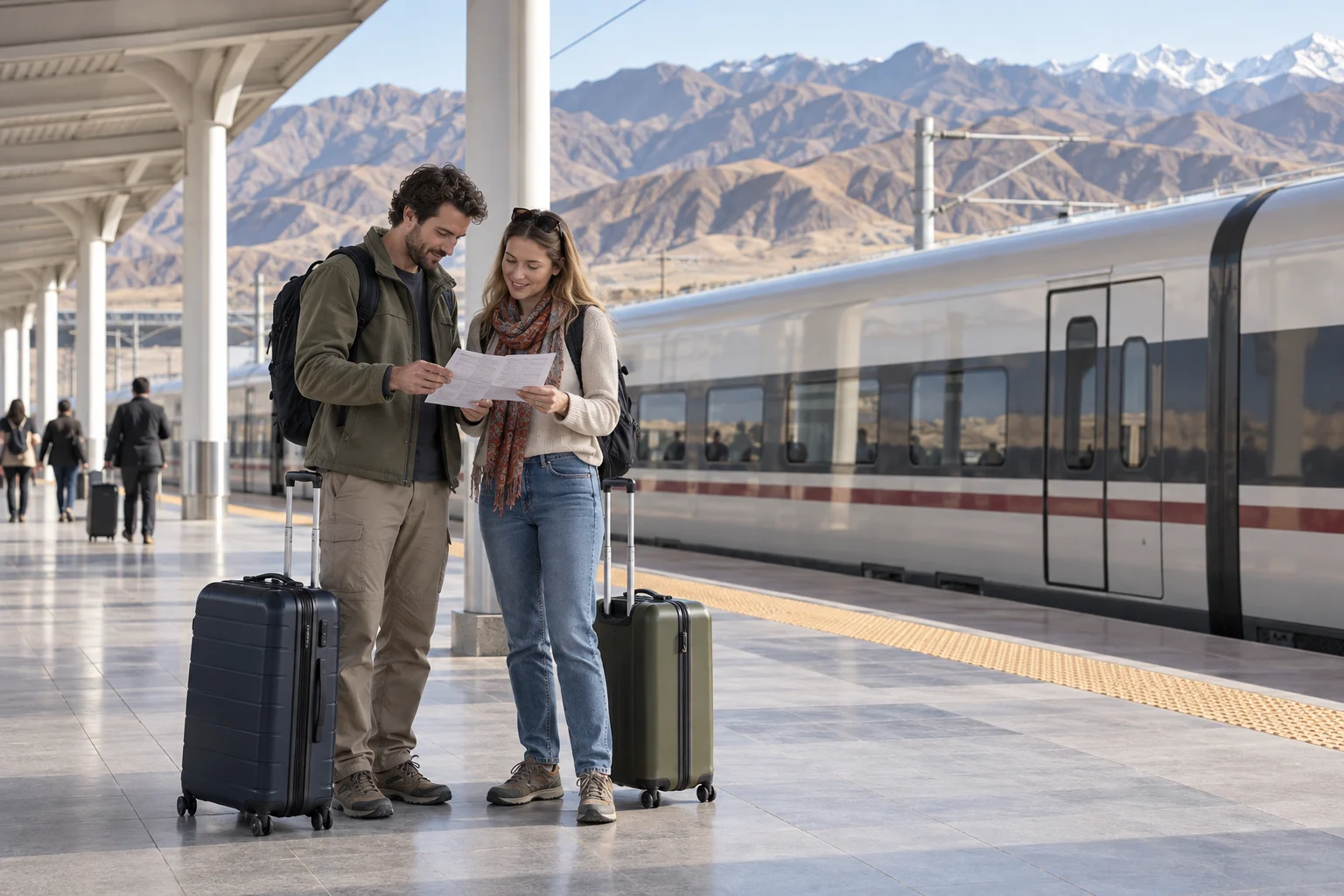
A train can be attractive when it links the cities you actually need at a useful time and avoids an airport transfer. It also gives you a fixed seat and keeps more of the journey at ground level. It is less helpful when the station is far from the planned route, the departure creates an awkward hotel night, or the remaining road transfer is still long.
China Railway’s official English 12306 information says foreign passengers can buy real-name tickets with a valid passport accepted under the applicable rules. It also states that the valid identity document used to buy the ticket must be carried for check-in, exit and boarding. Enter the passenger name and passport details carefully, keep the booking tied to the correct document, and allow time for security and identity checks.
Confirm the exact departure and arrival stations rather than relying on the city name alone. Share the number and size of bags with the planner, because the onward vehicle still needs enough luggage capacity. If the train is central to the itinerary, verify the dated service before making non-refundable arrangements around it.
Use a flight to protect a distant regional jump
A domestic flight can make sense when the alternative uses a large part of a day or forces an overnight that adds little to the trip. It is especially valuable when the two regions are separate priorities rather than points on one rewarding road corridor. Compare the date-specific flight, fare conditions, baggage allowance and airport transfers before treating it as the obvious answer.
Book the passenger name and identity details exactly as required by the airline or ticketing channel, and travel with the same valid passport used for the booking. Check the operating airport as well as the city label. Reconfirm the schedule before departure, because a route that appears in a general search may not operate every day or in every season.
Give a self-made flight connection breathing room. If one sector changes, separate tickets may not protect the next journey. An overnight in the gateway city can be worthwhile when it protects an international flight, a seasonal road departure or the only acceptable train the next day.
Keep the private vehicle where the road is part of the experience

A private vehicle is most valuable when the transfer itself contains the landscape, small stops or route flexibility you came for. It also reduces repeated handling of luggage between a hotel, station or airport. It cannot make Xinjiang’s distances disappear, and it should not be used to force a road day that ends too late or leaves no energy for the next visit.
Ask for the vehicle category, usable luggage space and the role of the driver and guide. A driver is not automatically an English-speaking guide, and a private vehicle may still stop at a scenic-area entrance where an internal shuttle takes over. For an airport or station transfer, exchange the actual arrival details and agree on a meeting point and a fallback contact method.
No compulsory shopping stop should be used to fill a road transfer or subsidize its price. A useful road day spends its time on scenery, meals, restrooms, short walks and the visits chosen for the route.
Build a mixed-mode itinerary in three steps
First, protect the fixed points: international flights, events, permits or dated accommodation that genuinely cannot move. Second, assign flights or trains to the connections whose only job is to move you between regions. Third, reserve private road time for the valleys, mountain approaches, oasis landscapes and local stops where being on the ground adds value.
Avoid changing mode simply to make the itinerary look varied. Every switch adds another check-in, luggage movement and chance of using the wrong station or terminal. Two well-chosen regional bases with one reliable connection often feel better than several one-night stops linked by ambitious transfers.
Before payment, ask the planner to label every sector as flight, train, private vehicle, shared group vehicle or scenic-area shuttle. The two illustrations in this guide were generated with AI to show common transport-planning situations; they do not document a specific service, station, airport or operator.
- Exact departure and arrival airport or station
- Door-to-door timing and arrival buffer
- Dated service status and ticket responsibility
- Passport-name match and document needed for travel
- Baggage allowance plus onward vehicle capacity
- Fallback if the connection changes or is missed
A useful request gives the planner the fixed facts
Send your international arrival and departure details, preferred regions, travel dates, group size, passport nationality, luggage estimate and any mobility needs. State whether you prefer fewer transfers, more scenery on the road or maximum time at the destination. Ask for one recommended transport plan and one realistic alternative for the most fragile connection.
The final decision should be based on the dated timetable and the actual hotel-to-hotel sequence, not a generic claim that one mode is always best. A mixed transport plan is successful when it protects the trip’s best experiences and makes the complicated days easy to understand.
Practical questions
Is flying always faster than taking a train in Xinjiang?
No. Compare hotel-to-hotel time, including airport transfers, check-in, security and baggage collection. A train can be simpler when both stations fit the route.
Can foreign travelers book Xinjiang train tickets with a passport?
China Railway’s official English guidance says foreign passengers can purchase real-name tickets with valid passports accepted under the applicable rules. Use the correct passport details and carry the same document for travel.
Should I use a private car for every Xinjiang sector?
Use private road transport where the route, stops and flexibility add value. A flight or train may better protect time between distant regions.
How much connection time should I allow?
There is no universal number. Consider separate tickets, baggage, terminal or station transfers, security, weather exposure and the importance of the next departure. Protect international flights with a conservative plan.